
In an increasingly competitive global market, efficiency is no longer just a metric for operational health; it is the definitive baseline for business survival. Organizations across every major sector face the simultaneous challenges of rising operational costs, labor shortages, and escalating consumer expectations. To navigate these hurdles, enterprises are abandoning legacy workflows and integrating advanced technological frameworks.
The current wave of industrial transformation is defined by the convergence of automation, real-time data streaming, and distributed intelligence. Technology solutions are removing the friction points that historically plagued supply chains, healthcare systems, agricultural landscapes, and construction sites. By converting unstructured operational environments into predictable, data-driven ecosystems, modern tech tools allow companies to maximize output while drastically minimizing waste and human error.
Advanced Logistics and Supply Chain Optimization
The global supply chain network is inherently complex and vulnerable to disruptions, ranging from geopolitical shifts to sudden extreme weather events. Legacy management systems relied heavily on retrospective data analysis, meaning operators only discovered bottlenecks after they caused financial damage. Modern tech systems introduce real-time clarity and predictive intelligence to logistics.
Telematics and Autonomous Fleet Coordination
Modern shipping and delivery fleets rely on advanced telematics platforms to optimize routes dynamically. These systems go far beyond basic GPS tracking; they collect continuous streams of diagnostic data from engine sensors, monitor driver fatigue levels, and evaluate ambient weather conditions.
Using predictive routing algorithms, the software automatically redirects drivers around traffic disruptions or mechanical hazards, shaving hours off delivery times and reducing fuel consumption across millions of miles. Furthermore, the gradual integration of autonomous line-haul trucks on major highway corridors is creating a continuous transit model, enabling freight to move safely without being restricted by human hours-of-service limitations.
Automated Warehousing and Inventory Orchestration
Inside modern distribution centers, the physical movement of goods has transitioned away from manual forklifts and clipboards. Intelligent warehouse execution systems deploy fleets of autonomous mobile robots to retrieve goods and bring them directly to packing stations.
By linking these robotic networks directly to real-time inventory databases, warehouses eliminate human scanning delays, maintain near-perfect inventory accuracy, and compress order fulfillment cycles from hours to minutes. This level of optimization allows businesses to operate with leaner inventory cushions, freeing up critical working capital.
High-Precision Industrial Automation and Manufacturing
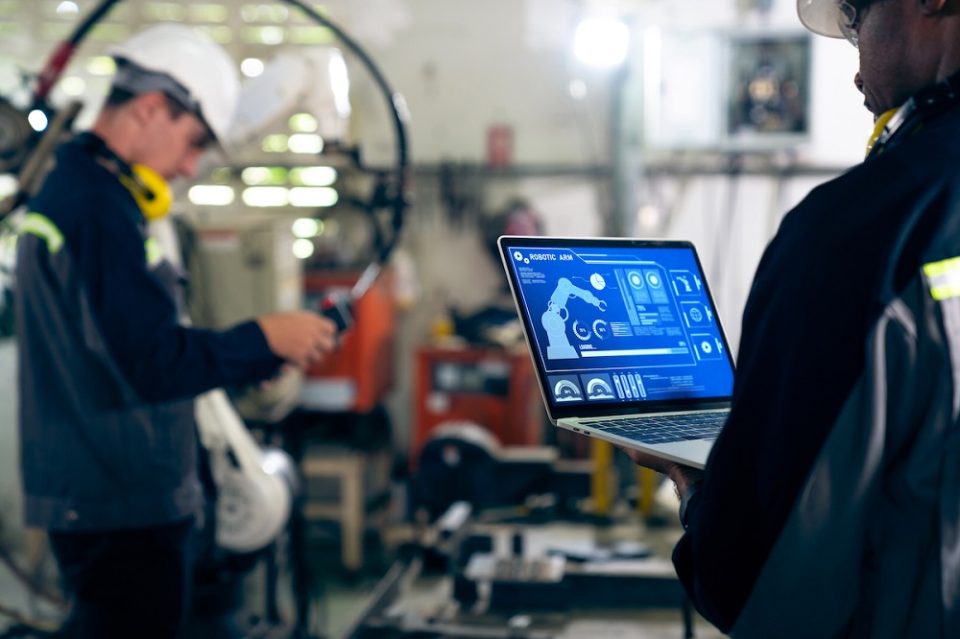
Manufacturing facilities have long utilized robotics for repetitive assembly line tasks. However, the latest generation of manufacturing technology shifts the focus from simple robotic repetition to highly adaptable, self-correcting production ecosystems.
Digital Twins and Predictive Simulation
A digital twin is a highly detailed virtual replica of a physical asset, production line, or entire manufacturing facility. By embedding hundreds of internet of things sensors across a physical factory floor, engineers feed real-time operational data directly into the digital twin model.
This connection allows plant managers to run infinite what-if scenarios in a risk-free virtual environment before altering physical machinery. It also facilitates predictive maintenance. By analyzing minute changes in machine vibrations, thermal signatures, or acoustic profiles, the software predicts precisely when a specific bearing or motor will fail, allowing maintenance teams to schedule repairs during planned downtime and avoid catastrophic unexpected stoppages.
Collaborative Robotics on the Factory Floor
Unlike traditional industrial robots that had to be confined inside heavy safety cages due to the risk of injuring human operators, modern collaborative robots, or cobots, are engineered to work safely alongside humans. Equipped with advanced proximity sensors, force-limiting joints, and computer vision systems, cobots automatically slow down or stop completely if a human worker enters their immediate space.
These agile machines take over physically taxing, monotonous, or hazardous tasks, such as heavy lifting, precision welding, and quality inspection, allowing human operators to focus on complex oversight, troubleshooting, and system optimization.
Data-Driven Precision Agriculture and Food Production
The agricultural sector faces the daunting task of feeding an expanding global population while managing diminishing arable land and increasingly unpredictable climate patterns. Tech solutions are transforming farming from an industry of traditional estimation into an exercise of extreme data precision.
Autonomous Field Equipment and Variable Rate Application
Modern farming equipment, such as tractors, seeders, and harvesters, utilizes real-time kinematic satellite navigation to guide machines through fields with sub-inch accuracy. This precision eliminates overlapping rows, reducing fuel consumption and minimizing soil compaction.
Furthermore, these autonomous machines implement variable rate application technologies. By parsing historical soil composition data and crop health metrics in real time, the equipment dynamically adjusts the exact volume of seeds, fertilizers, and water distributed to every square foot of soil, maximizing crop yields while preventing chemical runoff.
Remote Sensing and Drone Surveillance
Unmanned aerial vehicles equipped with multispectral and hyperspectral imaging sensors have become essential tools for modern agronomy. Drones fly pre-programmed flight paths over thousands of acres, capturing wavelengths of light that are completely invisible to the human eye.
The resulting imagery maps out specific regions of a field experiencing early stages of pest infestations, fungal outbreaks, or nutrient deficiencies long before the damage manifests visually to a farmer on the ground. This early localization allows for targeted chemical applications restricted to a few affected plants, rather than blanketing an entire field with expensive treatments.
Digital Integration in Healthcare and Clinical Operations
Healthcare systems worldwide struggle with administrative overhead, clinical burnout, and operational inefficiencies that can negatively impact patient care outcomes. Digital technology solutions are streamlining clinical workflows to maximize the time medical professionals spend with patients.
Ambient Clinical Intelligence and Documentation
One of the primary drivers of physician burnout is the immense volume of electronic medical record documentation required after every patient interaction. Ambient clinical intelligence systems use specialized microphone arrays and natural language processing models to securely capture conversations between doctors and patients during consultations.
The software automatically filters out casual dialogue, synthesizes the clinical facts, and drafts structured medical notes, prescription orders, and follow-up instructions for the physician to review and sign off on. This automation saves hours of manual typing every day, returning administrative time back to active patient care.
Predictive Patient Flow and Hospital Logistics
Hospitals are highly dynamic environments where unexpected influxes of patients can quickly overwhelm emergency rooms and intensive care units. Advanced operational command centers utilize predictive analytics to manage patient flow across entire medical networks.
By evaluating real-time emergency room admissions, scheduled elective surgeries, historical discharge patterns, and regional health data, the system projects bed availability up to forty-eight hours in advance. This foresight enables hospital administrators to optimize nurse scheduling, accelerate patient discharge protocols, and ensure that critical medical equipment is cleaned and positioned exactly where it will be needed next.
Frequently Asked Questions
What is the primary difference between a traditional automated factory and a smart factory?
A traditional automated factory relies on pre-programmed, rigid robotic systems that execute the exact same task repeatedly based on fixed code. If an input is misaligned or a component fails, the entire line typically stops until a human intervenes. A smart factory utilizes interconnected systems, sensors, and machine learning to create a flexible, self-correcting environment. Smart factories can analyze real-time production metrics, adjust machine parameters dynamically to fix quality deviations, and re-route workflows automatically around malfunctioning equipment without shutting down operations.
How does edge computing improve efficiency compared to standard cloud computing?
Standard cloud computing requires data collected by local devices or sensors to travel across the internet to a centralized server room for processing before returning an answer. This distance introduces data latency and requires significant internet bandwidth. Edge computing processes data directly on local microprocessors installed right next to the physical hardware. This localization enables split-second processing speeds, allowing autonomous vehicles or industrial machinery to react to changing environment variables instantly, while also reducing the need for constant high-speed internet connectivity.
Why is the construction industry historically slow to adopt tech solutions, and what is changing?
The construction industry has struggled with digital adoption due to the unique, highly unrepeatable nature of every physical job site, coupled with thin financial margins and a fragmented workforce of subcontractors. However, this is changing rapidly due to the introduction of building information modeling platforms and ruggedized mobile field software. These tools create a unified digital blueprint accessible by every contractor on-site simultaneously, reducing architectural miscommunications, eliminating structural clashes before building begins, and cutting down on expensive material rework.
How do smart grids improve the operational efficiency of utility companies?
Traditional electrical grids transmit power blindly from a central power plant to consumers, offering utility companies little visibility into local usage until problems occur. Smart grids utilize bidirectional communication networks, smart meters, and automated substations to monitor electricity demand in real time. This connectivity allows utility providers to balance loads dynamically, integrate intermittent renewable energy sources like wind and solar smoothly, predict local equipment failures before blackouts occur, and automatically reroute electricity around damaged power lines to minimize outage durations.
Can predictive maintenance software eliminate the need for regular calendar-based maintenance?
Predictive maintenance software does not completely eliminate regular maintenance; rather, it optimizes the schedule. Calendar-based maintenance often leads to companies replacing perfectly functional components prematurely, or conversely, experiencing machine failures right before a scheduled service date. Predictive maintenance replaces rigid calendars with condition-based monitoring, ensuring that machinery components are serviced exactly when the physical data indicates wear, thereby maximizing the lifetime of the component and preventing unnecessary downtime.
How does natural language processing improve efficiency in the financial services sector?
In financial services, natural language processing models automate the extraction and synthesis of data from millions of pages of unstructured text, such as regulatory filings, corporate earnings transcripts, and complex loan applications. What historically took teams of compliance officers or financial analysts weeks to read and evaluate can now be parsed in seconds. The software automatically flags compliance risks, extracts key financial performance indicators, and generates structured reports, allowing analysts to make rapid, data-verified investment decisions.
